

Content Menu
● What Makes Sapphire Suitable for Precision Rods?
● Start with the Sapphire Rod’s Primary Function
● How to Choose Sapphire Rod Material Quality
>> Define Purity Beyond a Percentage
>> Match Internal Quality to Optical Path Length
● Choose Crystal Orientation for the Actual Light Path
● Specify Sapphire Rod Dimensions That Control Assembly Performance
>> Diameter and Length Are Only the Beginning
>> Evaluate the Rod Together with Its Mount
● Match Surface Finish to Function
>> Separate End-Face and Cylindrical-Surface Requirements
>> Distinguish Scratch-Dig, Roughness, and Surface Form
● Evaluate Thermal and Mechanical Conditions Realistically
>> Do Not Use Melting Point as an Operating Limit
>> Treat Surface Damage as a Structural Concern
● Decide Whether an Optical Coating Is Necessary
● A Practical Three-Step Sapphire Rod Qualification Process
>> Step 1: Create a Function-Based Drawing
>> Step 2: Approve Samples Against Written Criteria
>> Step 3: Preserve the Approved Production Baseline
● Compare Suppliers by Evidence, Not Just Unit Price
● Request a Sapphire Rod That Fits Your Application
>> What is the difference between a sapphire rod and a ruby rod?
>> Does every sapphire rod need optical polishing?
>> Is c-axis orientation always necessary?
>> Can sapphire rods withstand rapid temperature changes?
>> What information should I include in a quotation request?
>> Should I choose the tightest available tolerances?
Choosing the right sapphire rod begins with understanding what the component must do—not simply selecting a diameter and length. A rod used for optical transmission needs different specifications from one used as a wear-resistant guide, semiconductor fixture, or precision support.
The most useful purchasing principle is application-first selection: define the operating conditions, identify the surfaces that matter, and specify how performance will be verified. Purity, crystal orientation, dimensional tolerances, polishing, and inspection should follow those requirements.
At CHENGDU COCREATION OPTICAL, our manufacturing scope includes cutting, grinding, ultra-precision polishing, shaping, inspection, and coating. This integrated capability supports a practical approach: matching each custom sapphire rod to its function, from initial samples and small batches to production quantities.
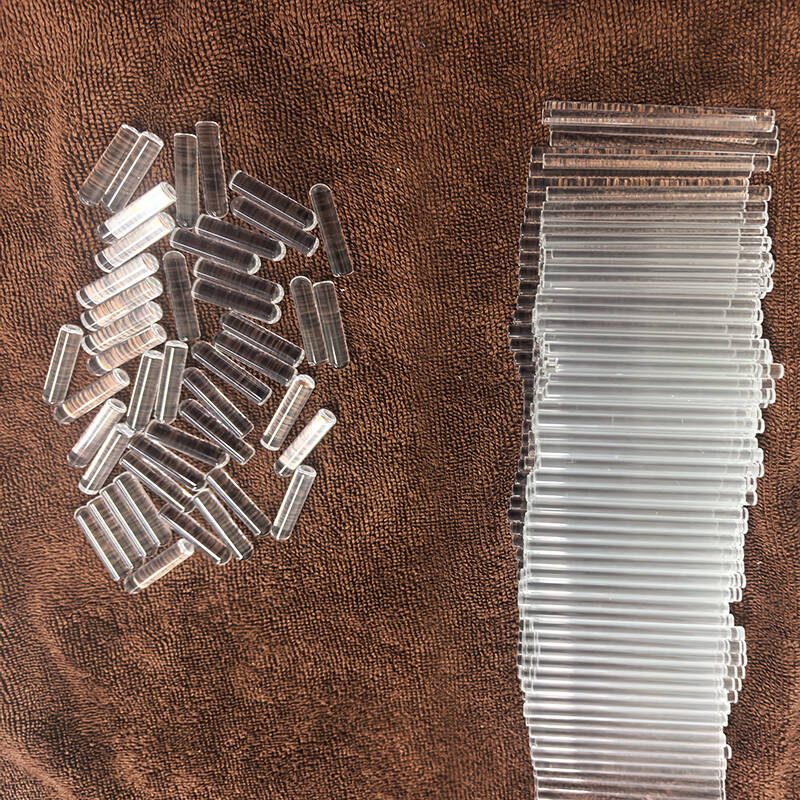
What Makes Sapphire Suitable for Precision Rods?
Synthetic sapphire is single-crystal aluminum oxide, or Al₂O₃. It combines optical transmission with high hardness and useful thermal and electrical properties. Unlike polycrystalline alumina, sapphire has a continuous crystal structure, making it valuable where optical clarity and controlled crystallographic orientation matter.
Published material data place sapphire’s nominal transmission range at approximately 0.17–5.5 μm. However, that range is not a guarantee that every finished rod will transmit equally well throughout it. Actual performance depends on wavelength, material quality, optical path length, surface finish, and coatings.
Sapphire is also anisotropic: some properties change with direction relative to the crystal axes. This makes crystal orientation a functional specification rather than a minor drawing detail.
For buyers, the key distinction is straightforward: sapphire’s material properties establish its potential, while manufacturing quality and component design determine whether the finished rod achieves the required performance.
Start with the Sapphire Rod’s Primary Function
Before requesting a quotation, identify the rod’s main job. A single component can serve several functions, but prioritizing them prevents unnecessary specifications.
| Application | Main selection priorities | Useful verification |
|---|---|---|
| Optical transmission | Wavelength, path length, orientation, end-face quality | Transmission and optical inspection |
| Precision mechanical support | Diameter, straightness, contact geometry | Dimensional inspection |
| Wear-resistant guide | Working-surface finish, alignment, edge condition | Surface and geometry inspection |
| Semiconductor equipment component | Material consistency, cleanliness, process compatibility | Agreed material and cleanliness records |
| High-temperature optical probe | Thermal gradients, mounting, optical stability | Representative thermal-cycle testing |
A practical first question is: “What would make this rod fail in our assembly?”
The answer might be excessive optical loss, binding in a sleeve, edge chipping, contamination, or cracking during temperature changes. Each failure mode leads to a different specification.
How to Choose Sapphire Rod Material Quality
Define Purity Beyond a Percentage
“High purity” is useful only when the supplier and buyer agree on what it means.
A nominal purity value does not fully describe inclusions, bubbles, internal stress, or the distribution of impurities. Depending on the application, these characteristics may matter more than a small difference in the stated chemical purity.
For demanding applications, discuss:
- Material identification and available purity documentation.
- Internal inclusions or visible defects.
- Coloration and its acceptance criteria.
- Lot traceability.
- Optical testing at the required wavelength.
- Application-specific contamination limits.
Do not assume that an unqualified “optical grade” label resolves these questions.
Match Internal Quality to Optical Path Length
A short optical element and a long sapphire rod do not impose identical transmission requirements. Light traveling through a longer material path has more opportunity to be absorbed or scattered.
For optical sapphire rods, state both the wavelength and the effective transmission length. Request acceptance data that represent the finished geometry where practical.
Colorless appearance alone does not establish ultraviolet or infrared performance.
Choose Crystal Orientation for the Actual Light Path
Sapphire is birefringent, meaning its refractive behavior depends on propagation direction and polarization.
For a rod transmitting light along its length, the relationship between the rod axis and the crystal’s c-axis can therefore matter. Propagation along the optic axis avoids the ordinary–extraordinary birefringent splitting associated with off-axis propagation in an ideal uniaxial crystal.
However, this does not make one orientation universally best. Mechanical loading, thermal behavior, polarization sensitivity, and manufacturing considerations also influence the choice.
A useful drawing should specify:
- The required relationship between the rod axis and c-axis.
- The permitted angular deviation.
- Any orientation-marking requirement.
- How orientation will be verified, if critical.
Avoid ordering “c-cut sapphire” without clarifying which surface or axis that term describes. For a cylindrical component, an explicit axis relationship is less ambiguous.
Specify Sapphire Rod Dimensions That Control Assembly Performance
Diameter and Length Are Only the Beginning
Two rods can meet the same diameter tolerance yet behave differently in an assembly because of straightness, roundness, or cylindricity.
Consider the complete geometry:
| Drawing feature | Why it matters |
|---|---|
| Diameter tolerance | Controls fit and clearance |
| Length tolerance | Controls axial position and stack-up |
| Straightness | Helps prevent misalignment in long assemblies |
| Roundness or cylindricity | Controls consistency of the cylindrical surface |
| End-face perpendicularity | Affects seating and beam alignment |
| End-face parallelism | Matters where both ends perform optical functions |
| Chamfers or radii | Define edge geometry and handling clearance |
Specify only what the design needs, but do not expect a diameter tolerance to control every geometric error.
Evaluate the Rod Together with Its Mount
A sapphire rod is not an isolated part once installed.
Clearance, clamping force, contact area, and differential thermal expansion can change its operating stress. A room-temperature fit may behave differently during heating or cooling.
Review the mounting arrangement with the supplier, especially for long rods, close-fitting sleeves, and assemblies exposed to thermal cycling. Avoid assuming that high hardness makes sapphire tolerant of concentrated loads or forced assembly.

Match Surface Finish to Function
Separate End-Face and Cylindrical-Surface Requirements
Different surfaces often need different finishing processes.
For axial optical transmission, the end faces may require optical polishing, while the cylindrical surface may need only a controlled ground or polished finish. For side-coupled light or a wear-contact application, the cylindrical surface may become the critical surface.
Identify each functional surface separately on the drawing.
This prevents a common cost problem: applying the most demanding finish to every surface even when only one region affects performance.
Distinguish Scratch-Dig, Roughness, and Surface Form
These specifications describe different characteristics:
- Scratch-dig evaluates certain visible surface defects.
- Surface roughness describes small-scale surface texture.
- Flatness or surface form describes larger-scale shape deviations.
A scratch-dig specification such as 20-10 is not a roughness value and does not establish flatness.
Optical guidance commonly associates 40-20 with many general optical applications and 20-10 with more demanding laser applications. These are starting points, not automatic requirements for every sapphire rod.
Specify the inspection standard and the surfaces it covers. Avoid choosing a tighter cosmetic grade unless it supports a measurable application requirement.
Evaluate Thermal and Mechanical Conditions Realistically
Do Not Use Melting Point as an Operating Limit
Sapphire’s melting point is approximately 2,040°C, but a finished sapphire rod assembly cannot be assigned that temperature as a safe working limit.
Its practical operating envelope depends on loading, atmosphere, temperature distribution, surface condition, mounting, and any coating or joining materials.
Published data give a representative thermal conductivity of approximately 27 W/(m·K) at 300 K. That value is condition-dependent, not a constant across all temperatures and orientations.
When requesting a high-temperature sapphire rod, provide:
- Continuous and peak temperatures.
- Heating and cooling rates.
- Temperature differences along the rod.
- Mechanical loads during operation.
- Mounting and contact materials.
- Expected cycle count.
Treat Surface Damage as a Structural Concern
Sapphire is hard, but it remains a brittle material. Surface defects and machining damage can influence fracture behavior.
Published research on sapphire strength and thermal shock shows that orientation, surface condition, defects, and loading conditions all matter.
Consequently, a generic strength number is not a sufficient design basis for a critical rod. Representative component testing is more informative when the application involves significant thermal gradients or mechanical stress.
Decide Whether an Optical Coating Is Necessary
Uncoated sapphire reflects part of the incident light at each optical interface. Published material data report approximately 14% reflection loss at 1.06 μm for the stated reference conditions.
An anti-reflection coating may improve throughput, but its specification must match the application.
Define:
- Operating wavelength or wavelength band.
- Angle of incidence.
- Polarization, when relevant.
- Required transmission or reflectance.
- Coated surfaces.
- Environmental and cleaning conditions.
A coating designed for one wavelength band should not be assumed suitable for another. Likewise, the coating’s durability may impose limits different from those of the sapphire substrate.
For non-optical rods, coating may add cost without providing a useful benefit.
A Practical Three-Step Sapphire Rod Qualification Process
Step 1: Create a Function-Based Drawing
Separate requirements into three groups:
- Critical: failure prevents the component from working.
- Important: variation affects performance or assembly yield.
- Noncritical: variation is acceptable within agreed limits.
For example, an axial light-transmission rod may require polished end faces and controlled orientation, while allowing a less demanding barrel finish.
This exercise helps the manufacturer focus precision where it creates value.
Step 2: Approve Samples Against Written Criteria
Do not approve samples solely because they look good.
Agree on dimensional measurements, optical tests, surface inspection, and any application testing before production begins. Record the drawing revision and acceptance criteria used.
If the rod works only in a particular mounting arrangement, qualify it in that arrangement rather than testing the loose component alone.
Step 3: Preserve the Approved Production Baseline
Once samples pass, define how production will remain aligned with them.
Relevant controls may include material traceability, inspection records, packaging requirements, and notification of significant process changes.
A successful prototype demonstrates feasibility. Repeatable inspection and controlled production establish purchasing confidence.
Compare Suppliers by Evidence, Not Just Unit Price
A meaningful sapphire rod quotation should identify what is included and what remains unverified.
Ask suppliers:
- Which manufacturing steps are performed internally?
- Which tolerances can be measured and reported?
- How are critical surfaces inspected?
- What material documentation is available?
- How are samples transferred into repeat production?
- What packaging protects polished faces and edges?
At CHENGDU COCREATION OPTICAL, our stated in-house capabilities cover cutting, grinding, ultra-precision polishing, shaping, inspection, and coating. These capabilities support coordinated review of geometry, finish, and optical requirements.
Specific tolerances, inspection methods, coating performance, and production capacity should still be confirmed for each project rather than assumed from general capability descriptions.
Request a Sapphire Rod That Fits Your Application
The right sapphire rod is the one whose material, orientation, geometry, finish, and verification match its actual working conditions.
Send CHENGDU COCREATION OPTICAL your drawing or application brief, including dimensions, quantity, operating environment, wavelength, functional surfaces, and inspection requirements.
For early-stage projects, identify unresolved specifications as well. This creates a clearer basis for technical review, sample planning, and a quotation that reflects what your component genuinely needs.

Frequently Asked Questions
What is the difference between a sapphire rod and a ruby rod?
Both use the corundum crystal structure. Ruby contains chromium that produces its characteristic coloration and changes its optical behavior. They should not be treated as interchangeable optical materials.
Does every sapphire rod need optical polishing?
No. Optical polishing is appropriate for surfaces that require the resulting optical or contact performance. Other surfaces may use a less demanding finish when the application allows it.
Is c-axis orientation always necessary?
No. It becomes important when direction-dependent optical, thermal, or mechanical behavior affects performance. The required orientation should follow the application, not a blanket purchasing rule.
Can sapphire rods withstand rapid temperature changes?
That requires application-specific evaluation. Thermal gradients, surface defects, orientation, mounting, and mechanical loads influence the risk of fracture. High-temperature capability alone does not guarantee thermal-shock resistance.
What information should I include in a quotation request?
Provide dimensions, tolerances, quantity, intended function, operating conditions, orientation requirements, surface specifications, coatings, and inspection criteria. Include a drawing whenever possible.
Should I choose the tightest available tolerances?
Only where they improve function. Unnecessary tolerances can increase manufacturing and inspection work without improving the installed component.
References
1. Crystran, “Sapphire Al₂O₃.” Source for representative transmission range, birefringence, refractive properties, thermal conductivity, melting point, and reflection-loss data. https://www.crystran.com/optical-materials/sapphire-al2o3/ | https://www.crystran.com/wp-content/uploads/2025/09/sapphire-al2o3-data-sheet.pdf
2. Edmund Optics, “Understanding Surface Quality Specifications.” Source for scratch-dig interpretation, inspection context, and example optical surface-quality grades. https://www.edmundoptics.com/knowledge-center/application-notes/lasers/understanding-surface-quality-specifications/
3. “Does Anyone Out There Know the Strength of Sapphire?” Defense Technical Information Center document. Source for the limitations of generic sapphire strength values and the influence of temperature and orientation. https://apps.dtic.mil/sti/tr/pdf/ADA421203.pdf
4. “Thermal Shock Resistance and Thermal-Mechanical Processing of Sapphire Single Crystals,” published through ScienceDirect. Source for the influence of orientation, stress conditions, defects, and processing on thermal-shock behavior. https://www.sciencedirect.com/science/article/abs/pii/S0955221902000936
Hot Tags: Sapphire Rod, Sapphire Rod Manufacturer, Sapphire Rod Supplier, Custom Sapphire Rods, Synthetic Sapphire Rods, High Purity Sapphire Rods, Precision Sapphire Rods, Optical Sapphire Rods, Polished Sapphire Rods, Sapphire Optical Components


