

Content Menu
>> Is Sapphire Crystal the Same as Sapphire Glass?
>> Natural Sapphire vs. Synthetic Sapphire
● Sapphire Crystal Properties: What the Numbers Mean
>> Optical Transmission and Surface Reflection
>> Hardness Does Not Mean Unbreakable
>> Thermal and Chemical Performance
● Types of Sapphire Crystal Used in Industry
>> Colorless Optical Sapphire and Synthetic Ruby
>> Optical and Semiconductor Requirements
● How Is Synthetic Sapphire Crystal Manufactured?
>> Common Sapphire Crystal Growth Methods
>> Precision Sapphire Component Manufacturing
>> Why Inspection Must Match Function
● Sapphire Crystal Applications Across Key Industries
>> Semiconductor Equipment and Components
>> Optical Windows and Laser Systems
>> Medical and Diagnostic Equipment
>> High-End Watch Covers and Smart-Device Windows
● Expert Procurement Insight: Specify the Function Before the Finish
>> A Practical Sapphire Specification Checklist
>> Illustrative Design Review: A Laser Sensor Window
>> Planning the Transition from Samples to Production
● Request Custom Sapphire Components
>> Is sapphire crystal real glass?
>> Is synthetic sapphire suitable for precision optics?
>> Can sapphire crystal break?
>> Does a sapphire window need an antireflection coating?
>> Why does crystal orientation matter?
>> What information is needed to quote a custom sapphire part?
Sapphire crystal is single-crystal aluminum oxide, valued for its optical transparency, surface hardness, chemical resistance, and thermal performance. Although often called “sapphire glass,” it is a crystalline material—not conventional glass. For manufacturers developing optical windows, semiconductor components, medical instruments, or premium watch covers, synthetic sapphire offers a combination of durability and light transmission that few materials can match.
At CHENGDU COCREATION OPTICAL, our focus is turning high-purity synthetic sapphire into precision components through cutting, grinding, ultra-precision polishing, shaping, inspection, and coating. From a manufacturing perspective, the key question is not simply whether sapphire is a good material. It is whether its orientation, geometry, surface finish, and coating match the application.
This guide explains sapphire crystal properties, types, applications, and manufacturing—and the specification decisions that determine finished-part performance.

What Is Sapphire Crystal?
Sapphire is a crystalline form of aluminum oxide, with the chemical formula Al₂O₃. Optical-grade synthetic sapphire is normally colorless. Its ordered crystal structure distinguishes it from glass and gives it direction-dependent optical and physical properties.
Sapphire is especially useful when an optical component must also act as a durable protective barrier. Examples include observation windows exposed to chemicals, sensor covers subject to abrasion, and medical windows requiring repeated cleaning.
Is Sapphire Crystal the Same as Sapphire Glass?
“Sapphire glass” is a common commercial description, particularly for watch covers. Technically, however, sapphire is not glass.
This distinction matters in precision optics. Sapphire is birefringent: light can experience different refractive indices depending on polarization and propagation direction. Consequently, crystal orientation belongs in the specification whenever polarization or image quality is important.
Natural Sapphire vs. Synthetic Sapphire
Natural sapphire forms geologically. Synthetic sapphire is grown through controlled manufacturing processes.
For industrial components, synthetic material allows producers to select growth methods and starting geometry for the intended application. Crystal growth nevertheless remains a critical quality step: manufacturing a transparent boule does not automatically guarantee suitability for every optical or semiconductor requirement.
Sapphire Crystal Properties: What the Numbers Mean
Material-property tables provide useful starting points, but they are not finished-component guarantees. Temperature, orientation, wavelength, thickness, and measurement conditions affect how the data should be applied.
| Property | Representative value or characteristic | Practical significance |
|---|---|---|
| Chemical composition | Single-crystal Al₂O₃ | Distinguishes sapphire from glass and polycrystalline alumina |
| Density | Approximately 3.97 g/cm³ | Relevant to component weight |
| Transmission range | Approximately 0.17–5.5 μm in a published material dataset | Actual useful transmission depends on the component |
| Refractive indices | Ordinary: 1.75449; extraordinary: 1.74663 at 1.06 μm | Important for reflection and polarization |
| Thermal conductivity | Approximately 27.21 W/m·K at 300 K | Supports thermal-management calculations |
| Melting point | Approximately 2,040°C | Not a permissible assembled-device operating temperature |
| Knoop hardness | Approximately 1,800–2,200, depending on direction | Indicates high resistance to surface indentation |
These representative values come from Crystran’s sapphire material data. They should be checked against the selected material and operating conditions before design release.
Optical Transmission and Surface Reflection
Sapphire transmits across ultraviolet, visible, and portions of the infrared spectrum. However, a transmission range describes a material’s spectral capability—not uniform transmission at every wavelength.
Reflection also matters. Crystran reports approximately 14% reflection loss across two uncoated surfaces at 1.06 μm. A suitable antireflection coating can reduce surface reflection, but it must be designed for the operating wavelength and application conditions.
The purchasing implication is straightforward: specify required transmission at actual wavelengths rather than requesting “high transparency.”
Hardness Does Not Mean Unbreakable
Sapphire’s high hardness supports wear-resistant windows and protective covers. Nevertheless, hardness should not be treated as proof that a component can withstand an arbitrary impact, pressure, or mounting load.
For engineering review, separate three questions:
- How resistant must the surface be to abrasion?
- What loads will the finished component experience?
- How will the mounting arrangement distribute those loads?
Published hardness data answer the first question more directly than the other two.
Thermal and Chemical Performance
Sapphire combines heat resistance, thermal conductivity, and chemical resistance. These properties explain its use in semiconductor equipment and medical optical windows.
However, “chemical resistant” should never replace a process-specific compatibility review. Likewise, a high melting point does not establish the allowable temperature of a coated, bonded, or sealed assembly.
Types of Sapphire Crystal Used in Industry
For procurement, “type” is best understood as several separate classifications: composition, growth method, orientation, and intended quality requirements.
Colorless Optical Sapphire and Synthetic Ruby
Colorless synthetic sapphire is used for transparent optical components. Synthetic ruby shares the aluminum-oxide crystal foundation but incorporates chromium-containing material during growth to produce its characteristic color. Orbray describes ruby production using small quantities of chromium oxide mixed with aluminum oxide.
These materials should not be treated as optically interchangeable. A ruby component requires its own transmission and application specifications.
Optical and Semiconductor Requirements
A sapphire window and a semiconductor-related component may require different acceptance criteria.
For a window, wavelength transmission and surface quality may dominate. For a semiconductor component, orientation, material purity, chemical exposure, and geometry may become more important. Published supplier information links sapphire to both electronic substrates and chemically demanding semiconductor equipment.
Terms such as “optical grade” therefore need measurable requirements behind them.
Crystal Orientation
Sapphire’s optical axis is its c-axis. Light traveling at an angle to that axis can exhibit birefringence.
Orientation deserves explicit discussion when specifying:
- Polarization-sensitive optical windows.
- Laser-system components.
- Substrates with crystallographic requirements.
- Parts whose direction-dependent properties affect performance.
For suitable window applications, aligning the optical axis normal to the window surface can reduce birefringence concerns for normally incident light.
How Is Synthetic Sapphire Crystal Manufactured?
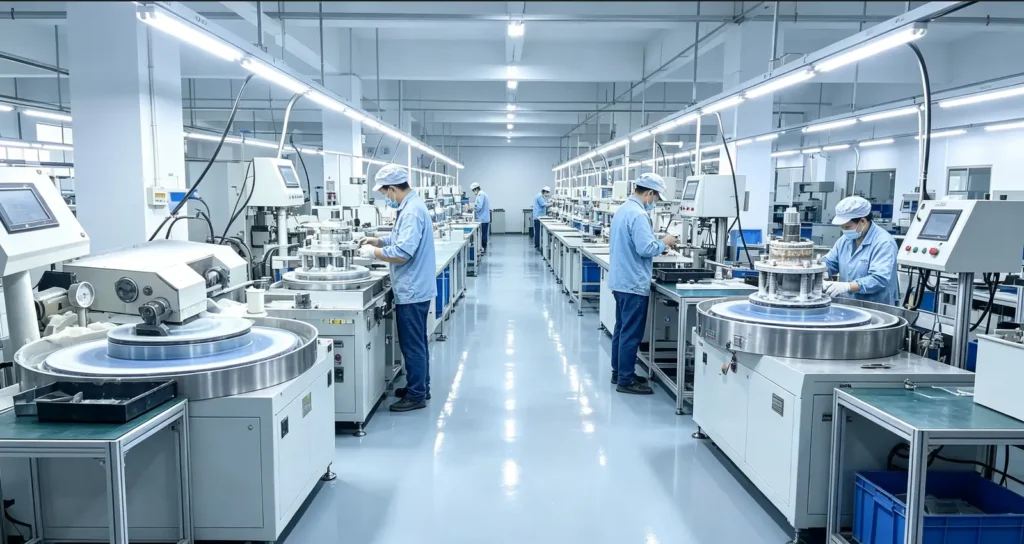
Sapphire manufacturing has two distinct stages: crystal growth and component fabrication. Growth establishes the starting material; fabrication converts it into the required finished geometry.
Common Sapphire Crystal Growth Methods
| Growth method | Basic principle | Manufacturing relevance |
|---|---|---|
| Verneuil | Flame-melted powder builds a crystal | Established route for synthetic sapphire and ruby |
| Czochralski | A seed is pulled from molten alumina | Allows controlled crystal growth |
| Kyropoulos | Crystal grows largely within a gradually cooled melt | Used for large sapphire crystals |
| Heat Exchange Method | Controlled heat removal supports seeded solidification | Developed for large sapphire production |
| EFG | A die supplies a shaped film of melt | Produces crystals with defined cross-sections |
Orbray describes these five methods and their operating principles. Growth-method selection involves geometry, quality, and production considerations rather than a universal “best” process.
Precision Sapphire Component Manufacturing
For CHENGDU COCREATION OPTICAL, component production draws on our stated in-house cutting, grinding, ultra-precision polishing, shaping, inspection, and coating capabilities.
A practical production plan typically addresses:
- Material selection and orientation requirements.
- Cutting or blank preparation.
- Grinding and dimensional shaping.
- Polishing of functional surfaces.
- Cleaning and inspection.
- Coating, where required.
- Final acceptance against the drawing.
The sequence should follow the component’s geometry and acceptance criteria, not simply a standard list of operations.
Why Inspection Must Match Function
A polished appearance alone does not establish optical performance. Conversely, demanding the finest finish everywhere may add cost without helping the application.
Separate requirements for optical faces, sealing surfaces, mounting features, and nonfunctional edges. This makes inspection more meaningful and allows manufacturing effort to focus on the surfaces that determine performance.
Sapphire Crystal Applications Across Key Industries
Semiconductor Equipment and Components
Sapphire is used for semiconductor-equipment viewports where heat, chemicals, and plasma exposure create demanding conditions. Industrial suppliers also describe sapphire plasma tubes, injector nozzles, and related components.
For these applications, the purchasing specification should identify the actual process environment. A generic material description cannot establish service life across different plasma chemistries.
Optical Windows and Laser Systems
Sapphire optical windows combine spectral transmission with environmental protection. Applications include sensor windows, optical communication packages, and laser-related components.
For laser use, distinguish a protective or transmitting sapphire component from a laser gain medium. The window specification should define wavelength, beam conditions, polarization requirements, and coating performance.
Medical and Diagnostic Equipment
Kyocera identifies sapphire endoscope windows as an application requiring optical transparency, chemical resistance, and sealing. Other supplier information lists medical and dental optical uses.
Material selection is only one part of medical-device qualification. The finished component and assembly still need application-specific validation, including cleaning compatibility and optical performance.
High-End Watch Covers and Smart-Device Windows
For watch covers and smart-device protective windows, sapphire’s appeal lies in combining transparency with a wear-resistant surface. The same material characteristics support optical sensing windows exposed to repeated contact.
Design priorities differ from those of a laboratory optic. Appearance, edge geometry, mounting fit, coating location, and viewing performance may be as important as the material itself.
Expert Procurement Insight: Specify the Function Before the Finish
Our manufacturing perspective is to begin with the operating conditions, then translate them into measurable drawing requirements.
A Practical Sapphire Specification Checklist
Before requesting a quotation, prepare:
- Application and operating environment.
- Dimensions, tolerances, and edge geometry.
- Crystal orientation, where relevant.
- Operating wavelength or wavelength band.
- Transmission and reflection requirements.
- Surface-quality and figure requirements.
- Coating requirements and coated surfaces.
- Cleaning, packaging, and inspection expectations.
- Prototype quantity and expected production demand.
“Best quality” is difficult to quote or verify. A defined acceptance criterion is more useful to both the buyer and manufacturer.
Illustrative Design Review: A Laser Sensor Window
Consider a sensor window operating near 1.06 μm. Selecting sapphire for durability does not resolve reflection losses; published data indicate approximately 14% loss across two uncoated surfaces at that wavelength.
The next design decisions concern coating, incidence angle, polarization, mounting, and operating temperature.
This is an illustrative engineering scenario, not a claimed customer project. Its lesson is that material selection and optical-system design must proceed together.
Planning the Transition from Samples to Production
A successful sample should demonstrate more than dimensional fit. Agree on acceptance methods early so that prototype results can be compared with later production batches.
For custom parts, discuss:
- Which characteristics are critical to function.
- How those characteristics will be measured.
- Which requirements must remain unchanged during scaling.
- What documentation will accompany production deliveries.
CHENGDU COCREATION OPTICAL supports samples, small batches, and scaled production, allowing these requirements to be addressed within a continuing manufacturing relationship.
Request Custom Sapphire Components
CHENGDU COCREATION OPTICAL manufactures sapphire rods, windows, semiconductor components, premium watch covers, ruby parts, and other customized precision components.
Send your drawing, operating wavelength, environment, quantity, and acceptance requirements for a manufacturability review and quotation. Our cutting, grinding, ultra-precision polishing, shaping, inspection, and coating capabilities support a coordinated discussion from initial sample development through production.

Frequently Asked Questions
Is sapphire crystal real glass?
No. Sapphire is single-crystal aluminum oxide. “Sapphire glass” is a commercial term, but the material is crystalline rather than conventional glass.
Is synthetic sapphire suitable for precision optics?
Yes, when its material quality, orientation, geometry, finish, and coating meet the application’s requirements. Synthetic optical sapphire is generally colorless and offers broad spectral transmission.
Can sapphire crystal break?
Yes. High hardness is not an unlimited guarantee against impact or structural failure. Evaluate the finished geometry and loading conditions separately from published hardness values.
Does a sapphire window need an antireflection coating?
Not always. A coating is useful when surface reflection compromises transmission or system performance. It should be matched to the required wavelength band and operating conditions.
Why does crystal orientation matter?
Sapphire is birefringent, so light propagation and polarization relative to its optical axis can influence performance. Orientation is particularly important in polarization-sensitive applications.
What information is needed to quote a custom sapphire part?
Provide a drawing, dimensions, tolerances, material and orientation requirements, optical specifications, coating details, quantity, and operating conditions. Identify critical acceptance criteria rather than relying only on a general grade description.
References
1. Crystran — Sapphire Al₂O₃: Optical Material Data. Source for composition, representative properties, transmission, refractive indices, reflection losses, and orientation considerations.
2. Orbray — Production of Sapphire. Source for Verneuil, Czochralski, Kyropoulos, Heat Exchange, and EFG growth methods, plus synthetic ruby composition.
3. Kyocera — Optical Components: Sapphire Windows. Source for optical, semiconductor, sensing, and endoscope applications, including coating considerations.
4. SHINKOSHA — Optical Properties of Sapphire. Source for transparency, optical-axis behavior, and birefringence.
5. Luxium Solutions — Sapphire Applications. Source for industrial sapphire applications and semiconductor plasma components.
6. SHINKOSHA — Applications of Sapphire Crystals. Source for sensor, medical, dental, and laser-related component examples.
Hot Tags: Sapphire Crystal, Synthetic Sapphire, Sapphire Optical Windows, Sapphire Crystal Manufacturer, Sapphire Components, Custom Sapphire Parts, Sapphire Rods, Sapphire Substrates, Sapphire Watch Glass, Precision Optical Components


